
Salon Website Design and Marketing for Independent Owners
A budget-first guide to salon website design, service menus, appointment journeys, local SEO and sustainable marketing for independent beauty businesses.
The quick read
Start with the essential answers.
Does an independent salon need a website if it uses Instagram?+
A website gives clients a stable place to find current services, prices or pricing guidance, location, policies and booking links. Social posts can support discovery, while the website helps visitors make a decision.
What should a salon website include first?+
Prioritize a clear service menu, team information, real portfolio images with permission, location and hours, and a working appointment route. Add retail or education features only when the business can maintain them.
Should the salon build its own booking software?+
Usually assess the booking system you already use before commissioning custom software. Check service duration, staff availability, deposits, cancellation policies and whether clients receive accurate confirmations.
What should an independent salon website do?
An independent salon website should help a new client understand the services, choose an appropriate appointment and arrive with accurate expectations. It should also reduce repetitive questions for the owner and front desk. A stylish homepage has value, but the practical test is whether someone can make a confident booking from a phone.
Small salons often already have active social accounts and a booking link. The website can connect these pieces into one reliable destination. It provides a current service menu, team information, location, policies and a route to the booking system. That foundation can be built before a large marketing program.
This guide is for independent hair salons and small beauty teams with limited budgets. The same planning questions can help related studios, but the exact services and professional requirements vary. Examples are illustrative; they are not Brands Essential client results or claims about a particular salon.
Brands Essential can help understand the salon's customer, capacity and available spend, then propose a practical first website and ongoing marketing plan. AI can speed up some content production, while the business remains responsible for service details, client permissions and final approval.
Start with the services people actually book
List the current service menu and the decisions a client must make. A basic haircut, a color consultation and a correction appointment may need different explanations. If clients repeatedly choose the wrong service in the booking system, the website should help them choose more accurately.
For each important service, explain who it suits, what the appointment generally includes, whether consultation is required and what affects timing or price. Use words clients understand. A salon's internal shorthand can be efficient for the team but confusing to a first-time visitor.
Do not list every possible variation as a separate page simply to capture search terms. Create distinct pages when there is enough real information to answer a different client question. A short, well-organized service menu may be easier to maintain than dozens of near-identical pages.
Review whether the team can deliver the demand the website invites. If a specialist service is available only with one stylist on limited days, say how clients should enquire. Good marketing aligns interest with actual capacity rather than creating disappointment after someone has chosen a time.
Make pricing guidance useful and honest
Many clients want to know whether a service is within reach before they book. A salon can publish fixed prices where the work is standardized, or starting prices and ranges where time and materials vary. Explain the conditions that affect the final amount.
If a consultation is required, state what happens during it and whether a fee applies. Do not let the website present a starting figure as a final quote when the actual work may be substantially different. Transparent wording protects both the client and the stylist.
Someone should own price updates. A menu in the booking platform, another on the website and a third in a social highlight can drift apart. Decide which source is authoritative and how changes are synchronized before publishing an elaborate pricing page.
Compare a prospective website provider by asking how the owner will change a price or service duration. The answer matters to a busy salon. A low launch cost loses its appeal if routine corrections require a developer every time.
Connect the appointment journey end to end
Map the path from a service page to the final booking confirmation. Which tool shows staff availability? Can a client pick the correct stylist? Is a deposit required? What happens when an appointment request needs review? The website should explain the actual process.
An existing booking platform may be a sensible choice for a small team. Test the link rather than assuming it works. A generic landing page that makes clients reselect the business or service adds friction. If direct service links are available and reliable, they may simplify the journey.
Use accurate button labels. “Book now” suggests a confirmed reservation. If the salon reviews requests manually, choose language that reflects that. Clarify cancellation and rescheduling instructions, using policies the owner has approved and can enforce consistently.
Test common cases: a new client choosing the wrong service, a fully booked stylist, a deposit interruption and someone using a small phone. Ask whether the confirmation is easy to recognize. The most valuable website change may be a clearer handoff, not a more elaborate visual effect.
Show the people and work behind the salon
Clients often choose a salon based on style, personality and trust. Use genuine staff profiles and a small, well-curated portfolio of real work where permission has been obtained. Explain stylist specialties without inventing credentials or promising outcomes.
Before-and-after content deserves context. Lighting, editing and hair history can affect how a result appears. Obtain client consent for publication and avoid presenting one outcome as what everyone can expect. A portfolio should help a prospect decide fit, not make a false guarantee.
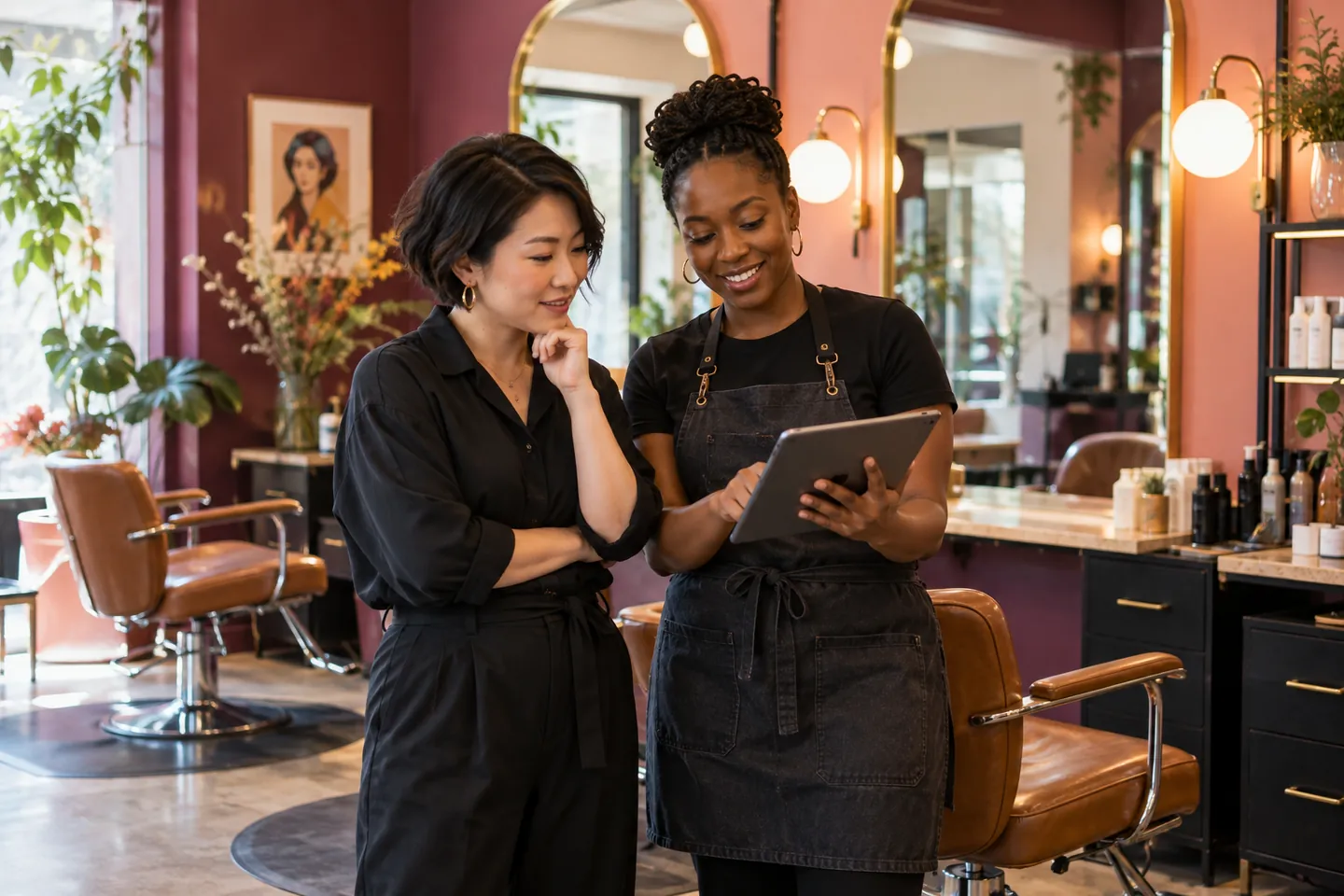
Generated imagery can support an illustrative editorial article, like this guide. It should not masquerade as real client transformations, staff or premises. The real salon's photographs can be modest and still more persuasive because they show what the business actually does.
Reviews must be authentic. The FTC explains risks involving fake testimonials. Never use AI to create a glowing client quote or selectively present fabricated ratings. Invite feedback through a process the business is comfortable maintaining.
Build the minimum useful website
A first release can include a homepage, service menu, team section, location and hours, contact information and a booking route. Add a small FAQ for recurring questions about preparation, consultations or policies. The page structure should reflect the salon's actual decision journey.
The homepage can state the salon's style, audience and location, then lead to services and booking. A new visitor should understand whether the business is a good match without needing to inspect every social post. Keep the essential words as readable text, not only embedded in images.
The location page should include verified practical information, such as entrance, parking or transit details where relevant. Ensure the phone number and hours are current. A beautiful photograph cannot compensate for a client arriving when the salon is closed.
Defer features that have no clear owner, such as a complex retail store, membership program or automated consultation quiz. They may be useful later. A small launch leaves time and budget to make the appointment journey reliable before expanding scope.
How much should a salon website cost?
The answer depends on the content, design, booking integration, photography and support required. Ask for a scope that separates strategy, copy, design, development, migration, testing and training. Include recurring hosting, booking software and maintenance in the comparison.
An inexpensive template can be appropriate when the content and booking process are already clear. A custom design may be justified when the salon has distinct services, a stronger brand need or complex integration. The decision should follow the business problem, not the provider's favorite package.
Set aside part of the budget for post-launch changes. A salon may discover that clients keep booking the wrong slot or cannot find a price condition. Fixing those issues can have more value than adding a new page simply to make the site look larger.
Use our website project planner to prepare scope and cost questions before comparing proposals.
Clarify ownership of the domain, booking account, images and website content. The business should be able to update routine information and understand what happens if it changes suppliers. A manageable website is one the salon can continue to operate.
Local SEO should reflect the salon people can visit
Use the actual business name, location, services and hours. Google provides business-hours guidance, and consistent information helps customers plan a visit. Update changes across the website and profiles rather than letting one channel lag behind.
Describe the services clients search for in ordinary language. A useful page explains the appointment, relevant choices and next step. Repeating the city name after every service term does not replace that explanation.
Separate locations only when the business really operates them. Do not create city pages implying a salon exists in a place where it does not. Nearby clients can still be reached through truthful location information and helpful service pages.
Add direct answers to practical questions, such as whether consultation is required, how pricing works and how to reschedule. These answers help people and can make the site's content easier for search systems to understand.
AEO builds on clear, accurate answers
Answer engine optimization is often presented as a new set of tricks. The useful task for a salon is simpler: answer real questions in clear text and keep those answers current. A person should understand the response without reading a paragraph of promotional language first.
Google's AI search guidance says the same foundations used for search remain relevant to AI features. There is no markup or article length that guarantees inclusion. A business should invest in helpful content and a working customer journey rather than a ranking promise.
Structured information should match the visible page. Do not add review scores or service details in hidden code when the website does not support them. Accuracy is especially important when prices, staff availability and salon policies change frequently.
Measure whether people book the right appointments and ask fewer clarifying questions. A high ranking for a broad term may be less useful than a smaller number of suitable local clients who understand the service before arriving.
Use AI where it saves time without inventing results
AI can help turn approved service notes into first drafts, suggest headings for an FAQ and adapt an approved story into short posts. It may help organize a content calendar around real events, such as a new stylist or an updated service menu.
Someone in the salon must check every claim. A generated caption can invent a promotion, misstate a price or describe a result that the stylist cannot guarantee. Use real client permissions and images for portfolio posts. Do not use AI to simulate testimonials.
Brands Essential can combine AI-assisted production with human creative and strategic review. The salon supplies service reality and final approval. This keeps the site attractive while protecting the trust that brings clients back.
Avoid building a publishing machine that needs more time than the owner can give. A few accurate updates are better than daily generic posts that say little about the actual team or work.
Ongoing marketing should fit the appointment book
Choose a priority based on capacity. A salon may need more weekday appointments, more consultations for a specialist service or stronger retention among existing clients. Different goals require different pages and messages. “More followers” is not a complete marketing objective.
Use recurring client questions to guide content. If people repeatedly ask about maintenance after a service, write a reviewed explanation. If first-time clients are uncertain which appointment to choose, improve the service menu. Content should solve an observed communication problem.
Social channels can show the team's personality and real work. Link posts to the appropriate service or booking route, not only to a generic homepage. Keep promotions aligned with available slots and approved terms.
Paid campaigns should follow a working booking process. Sending more people to confusing service choices can create extra administration. Fix the journey, measure suitable bookings and then decide whether additional promotion is justified.
A practical first 90 days
Start by reviewing the service menu, prices, booking system and common questions. Decide what the first website must explain. Gather approved photographs and team details. Assign owners for content and policy approval.
Build the core pages and connect the booking flow. Test with someone who has never visited the salon. Ask them to choose a service, find the price guidance and complete a sample appointment. Observe where they hesitate.
After launch, compare the bookings received with what the team expected. Are clients selecting the right service and duration? Which policies still trigger questions? Improve the weakest part of the journey before expanding the content library.
This sequence is illustrative rather than a fixed delivery schedule. Existing tools, image readiness and staff approvals affect timing. A phased scope makes those dependencies visible before the salon commits its budget.
Compare providers by the experience of a new client
Give each website provider the same realistic scenario: someone new to the salon wants a service but is uncertain which appointment length to select. Ask the provider to show how the site will help that person understand the options, see price guidance and reach an appropriate booking route. A visual mockup alone cannot answer that question.
Ask what happens when the salon changes a service name, price or stylist. Will the website and booking platform show the same information? Who is responsible for keeping them aligned? A provider should be able to explain the process and demonstrate ordinary updates before the salon commits.
Review the handover as a deliverable. It should include account ownership, access for the right people, a simple update guide and an explanation of third-party fees. Those details matter to an independent owner who cannot pay for a new project every time the menu changes.
Finally, ask how success will be reviewed. A good plan should connect the website to suitable appointment requests and fewer confused bookings, while recognizing that staff capacity and service quality also affect outcomes. A claim to guarantee a certain number of new clients from a page design is not a useful basis for the decision.
Build repeat visits into the communication plan
Acquisition is only part of a salon's growth. Existing clients may need clear instructions for rebooking, maintenance or trying a related service. Explain these journeys without overwhelming a first-time visitor with every offer at once.
Ask which questions appear after an appointment and which can be answered through approved follow-up content. A short, accurate guide may help clients care for a service and understand when to book again. It should reflect stylist advice, not AI-generated assumptions about hair or skin.
Measure whether clients return and whether the appointment mix suits the team's schedule. Those business signals can guide future content and promotions more effectively than publishing frequent posts simply to remain visible.
How Brands Essential can help
Share your service menu, booking tool, social presence, location and budget range. Brands Essential can discuss a website and marketing plan that focuses on the client journey most important to your business. That may mean building a focused new site or improving an existing one.
We can help with positioning, design, copy, content planning and ongoing marketing support. AI-assisted production can make execution more efficient, while the salon remains the source of truth for services, pricing, availability and client imagery.
A useful proposal should state what launches now, what can wait, what each part costs and who maintains it. Small businesses deserve a plan they can operate after the excitement of launch fades.
If your salon is ready for a clearer path from discovery to booking, contact Brands Essential about your salon website and marketing. Tell us your priorities and the budget you need the plan to respect.
Published October 6, 2026. Examples and cover imagery are illustrative, not real clients or guaranteed results.
Frequently asked questions
Questions, answered
Does an independent salon need a website if it uses Instagram?
A website gives clients a stable place to find current services, prices or pricing guidance, location, policies and booking links. Social posts can support discovery, while the website helps visitors make a decision.
What should a salon website include first?
Prioritize a clear service menu, team information, real portfolio images with permission, location and hours, and a working appointment route. Add retail or education features only when the business can maintain them.
Should the salon build its own booking software?
Usually assess the booking system you already use before commissioning custom software. Check service duration, staff availability, deposits, cancellation policies and whether clients receive accurate confirmations.
How should a salon show prices online?
Publish accurate starting prices or ranges only when the conditions are clear and the owner approves them. Explain when a consultation is needed before a final quote, especially for work with variable time or materials.
Can AI create salon marketing content?
AI can help draft captions and organize approved service information. People must check prices, availability and results. Do not use generated images as if they were actual client transformations or invent reviews.
How can Brands Essential help an independent salon?
Brands Essential can discuss a phased website and marketing plan based on the salon's services, staff capacity and budget. The goal is a clear client journey and sustainable content, with scope and fees agreed before work begins.
Turn your expertise into a site people, and search systems, understand.
Brands Essential combines website strategy, design, development, SEO and answer-engine readiness into one focused build.
Keep exploring
More Website Development ↗
Accounting Firm Website Design and Marketing on a Small Budget
A practical guide to website design, qualified enquiries, SEO and ongoing marketing for independent accountants and small bookkeeping firms.
Read insight
Boutique Ecommerce Website Design and Marketing on a Budget
A practical guide to affordable online store design, product pages, checkout, SEO and sustainable marketing for independent boutiques and small makers.
Read insight
Fitness Studio Website Design and Marketing on a Budget
Plan an affordable fitness studio website with clear class schedules, membership choices, trial journeys, local SEO and practical ongoing marketing.
Read insight