
Pet Grooming Website Design and Marketing on a Small Budget
Plan a pet grooming website with clear services, appointment expectations, local discovery and a marketing scope that fits an independent business.
The quick read
Start with the essential answers.
What should a pet groomer's first website include?+
Show the services and animals the business accepts, the actual location or mobile coverage, the appointment process and approved preparation information. Use a clear contact route for cases that require discussion.
Should pet grooming appointments be booked instantly?+
Choose a booking process that reflects how the groomer assesses time and suitability. If staff review requests before accepting them, label the action as a request and explain how confirmation works.
How should a groomer present prices?+
Publish only approved prices or pricing guidance. Explain which service details require review before a final quote, and keep the website and booking tool consistent.
Build the website around a clear appointment process
For an independent pet groomer, we recommend a website that helps owners understand the service and reach the correct appointment route. Begin with the business's actual intake process. Decide what the groomer needs to review before accepting an appointment and which details can wait until direct contact.
A website should not create a booking promise that the team cannot support. If requests are reviewed before confirmation, make that clear. If an established booking system confirms appointments, explain the next step and test the handoff from the service page.
This is a website and marketing planning guide. It does not provide animal-care advice or state requirements for running a grooming business. Service suitability and preparation instructions should come from the business's approved professional process.
Describe the offer with enough detail to establish fit
List the services currently offered and the animals accepted. Avoid copying a broader competitor menu if the business does not provide every item. A visitor should be able to tell whether to enquire without interpreting unfamiliar service shorthand.
For each service, identify what is included at a high level, what needs discussion and how the appointment is arranged. Have the groomer approve the wording. A designer should not infer a treatment, duration or care claim from a photograph.
Create distinct pages only where the decision differs. A mobile appointment may need coverage and arrival information. A salon visit needs a truthful location and drop-off process. If services share the same questions, one clear menu may be easier to maintain.
Write the website brief using your actual intake decisions. What information changes appointment length or suitability? What questions should lead to a conversation rather than an automatic selection? These answers should shape the page and form.
Choose booking software by its behavior
Before buying a new platform, document what the current system does well and where it causes confusion. Ask whether the problem is software, unclear service names or inconsistent information. Fixing the explanation may be enough for a first release.
Evaluate a tool using the business's own appointment process. Can staff review a request? Can the right service be selected? Does the confirmation state the correct status? What happens when an appointment is changed or declined?
Use button labels that describe the outcome. A request form should not read like a confirmed reservation. If the system offers a waitlist, explain whether joining it creates any commitment or simply registers interest.
Test the customer and staff sides. Submit a sample enquiry, inspect what the team receives and check the confirmation. A website is not ready merely because a button opens another page.
Keep intake information proportionate
Select fields because the team needs them for a specific decision. Contact details, the animal type, the requested service and a short context field may be enough for initial contact. The business should decide what other information belongs in a later approved process.
Avoid asking for unnecessary personal information in a public marketing form. Plan where submissions go, who can access them and what the customer is told. Do not add a conversational AI tool without understanding how it handles the information entered.
If images are requested, state their purpose and provide another way to enquire. Do not treat a photograph as a complete assessment or let an automated response imply that it confirms suitability.
Give customers a visible contact route for questions the form cannot resolve. The website should help people reach the business, not force every situation into a menu of standard options.
Show pricing guidance that the business can honor
Have the owner approve all prices and conditions. Where a final amount requires review, explain which information informs that review. Avoid presenting a starting figure as a complete quote.
Keep the service menu and booking tool aligned. Decide which person updates prices and how changes reach each public channel. Include this maintenance task in the website handover.
For the website project, compare the full scope. Ask about copy, design, development, integrations, image preparation, training and recurring fees. A proposal should state what depends on the owner supplying approved information.
Our website project planner can help prepare a scope discussion. The recommendation here is to compare deliverables and ongoing obligations, rather than rely on an unverified universal cost estimate.
Use truthful location and coverage information
Google's service-area documentation distinguishes a business that visits customers from a hybrid business that also receives them at its premises. Review the guidance against your operation before publishing profile details.
For a salon, describe the real entrance, contact arrangements and appointment hours. For a mobile service, state the actual places visited. Do not create pages or profiles implying branches that the business does not operate.
Use practical information the owner can verify. If parking, access or arrival instructions matter, check them before publication. Do not fill a location page with guessed neighborhood details.
Keep a review process for coverage and schedule changes. A page can remain discoverable after the business changes its service model, so the owner should know which information needs updating.
Build trust with verified people and work
Introduce the real team with approved roles and credentials. Do not infer a qualification from a social profile or add an award that cannot be verified. Short, accurate descriptions can help an owner understand who will handle the appointment.
Use real portfolio images only when the source and publication permission are clear. Describe the actual work shown. Do not add an invented animal name, owner quote or transformation claim to make a caption more engaging.
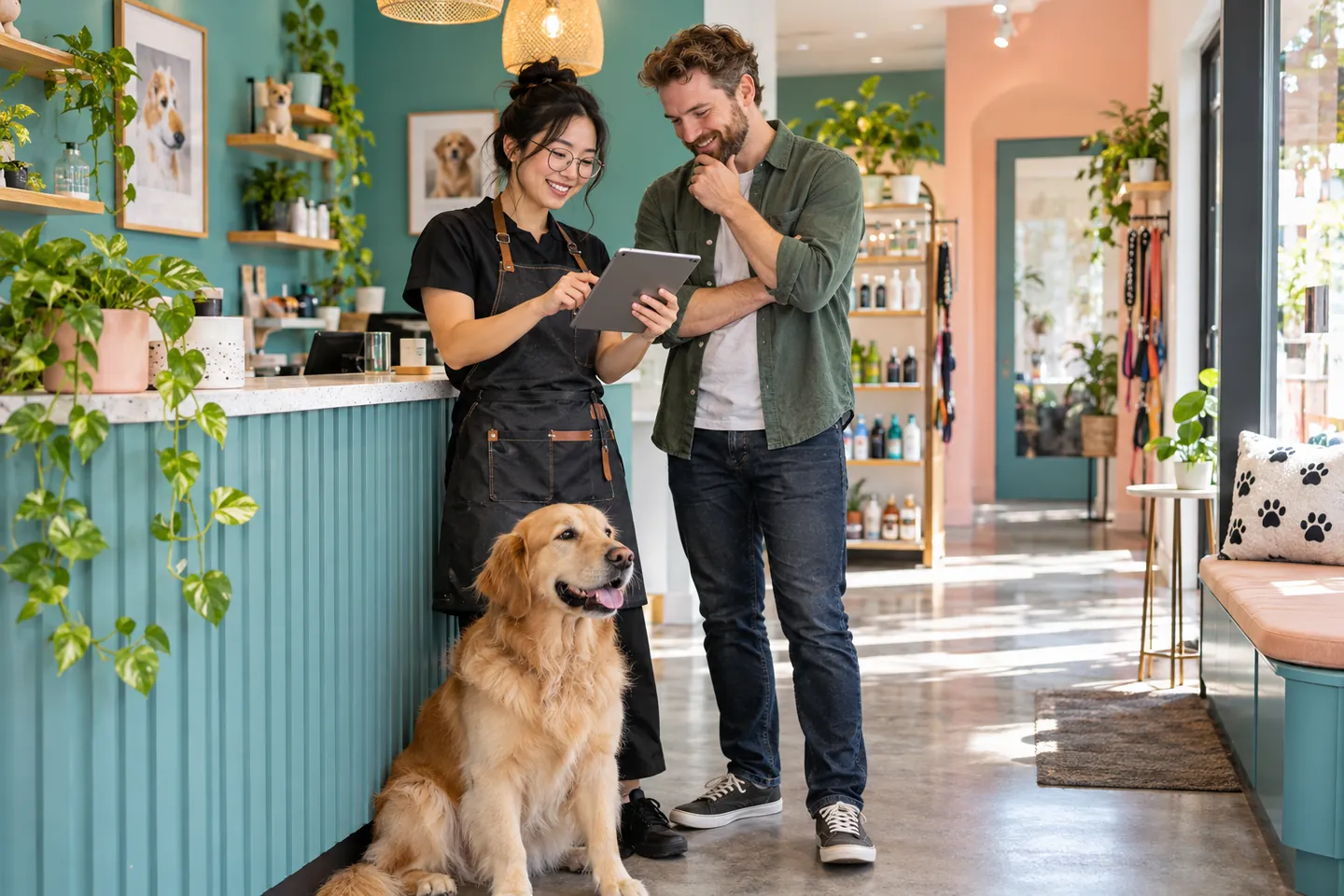
The cover of this guide is an editorial illustration. It should not be treated as a photograph of Brands Essential clients or a grooming result. Apply that same distinction if generated imagery is used on a business site.
If the business publishes reviews, preserve their authentic meaning and provenance. Do not manufacture testimonials or rewrite them into a stronger claim than the customer made.
Make the first release easy to maintain
We recommend starting with service information, location or coverage, a team introduction and a tested appointment route. Add an FAQ for recurring administrative questions. The precise page count should follow the process rather than a template package.
Ask the provider to show how staff will change a service name, price condition or booking link. Check whether those changes require editing several systems. A handover should identify the source of truth for each piece of information.
Defer features without an operational owner. A loyalty program, customer portal or automated content system needs maintenance as well as setup. Include it when the business can explain its purpose and ongoing cost.
SEO and AEO for a grooming website
Write pages that answer the decision in front of the visitor. Explain what the service covers, where it is available and how to arrange it. Use headings that describe the subject rather than repeat an awkward search phrase.
For direct answers, keep conditions attached to the statement. If a price or appointment depends on review, include that condition in the answer. An isolated sentence should not imply a stronger promise than the full page supports.
Google's AI search guidance makes clear that established SEO practices remain relevant and inclusion is not guaranteed. Clear content is a sensible foundation, but it cannot establish a guaranteed ranking or recommendation.
Google may also choose search snippets from page content, sometimes using the meta description, as described in its snippet guidance. Write an accurate description of the page without treating it as a guaranteed search-result message.
Use AI with an approved source of facts
Consider AI for first drafts based on a verified service sheet. It can be used in a proposed workflow for organizing notes or adapting approved information into shorter formats. Test the tool and review the output before relying on it.
Check services, prices, qualifications, location claims and image descriptions. Remove any detail that the business cannot verify. Do not use a generated answer as authority for animal-care or appointment-suitability advice.
Brands Essential describes its service approach as combining creative work, experience and AI-assisted efficiency. Discuss what that means for your actual project, including approvals and deliverables. The company's positioning should not be treated as evidence of a guaranteed client outcome.
Plan ongoing support around real questions
Choose a priority the business can support, such as making service choices clearer or improving enquiries from the actual coverage area. Link content and any promotion to the relevant page and appointment route.
Keep a record of the questions staff still answer repeatedly. Those questions can guide page improvements. Review whether enquiries are suitable, whether appointment status is understood and whether people arrive with accurate expectations.
If you want to discuss a plan that respects your scope and budget, contact Brands Essential about your pet grooming website. Share the service menu, booking tool, coverage and the main difficulty in the current process.
Sources and references
- Google Business Profile Help, Manage your service areas for service-area and hybrid businesses, checked October 8, 2026.
- Google Search Central, AI features and your website, updated December 10, 2025; checked October 8, 2026.
- Google Search Central, Control your snippets in search results, checked October 8, 2026.
- Brands Essential, company website and service positioning, checked October 8, 2026.
Frequently asked questions
Questions, answered
What should a pet groomer's first website include?
Show the services and animals the business accepts, the actual location or mobile coverage, the appointment process and approved preparation information. Use a clear contact route for cases that require discussion.
Should pet grooming appointments be booked instantly?
Choose a booking process that reflects how the groomer assesses time and suitability. If staff review requests before accepting them, label the action as a request and explain how confirmation works.
How should a groomer present prices?
Publish only approved prices or pricing guidance. Explain which service details require review before a final quote, and keep the website and booking tool consistent.
Does a mobile groomer need different location information?
Yes. Describe the places the business actually visits and review Google's service-area Business Profile guidance. Avoid implying that customers can visit a location that is not a public storefront.
Can AI create grooming portfolio images?
Generated imagery can be labeled as illustration. It should not be presented as an actual groom, client animal or result delivered by the business. Use verified work and permission for portfolio evidence.
Can Brands Essential help with grooming website marketing?
Contact Brands Essential to discuss services, booking tools, coverage and budget. Request a proposal that identifies launch work, content approvals and recurring support separately.
Turn your expertise into a site people, and search systems, understand.
Brands Essential combines website strategy, design, development, SEO and answer-engine readiness into one focused build.
Keep exploring
More Website Development ↗
Auto Repair Website Design and Marketing for Independent Shops
Plan an independent repair shop website with clear services, appointment requests, estimate expectations and marketing that fits the shop's budget.
Read insight
Interior Design Website and Marketing for Independent Studios
Plan an interior design website with a verified portfolio, clear service scope, useful project enquiries and marketing that fits an independent studio budget.
Read insight
Affordable Landscaping Website Design and Marketing
Plan a landscaping website around real services, project enquiries, honest coverage and a manageable marketing budget with this practical owner guide.
Read insight